Within a single week in November 2026, Paraguay closed a bank used by almost three million depositors, impeached its president, swore in his deputy and watched the ousted leader go to pretrial detention. For anyone holding a cédula or planning a move, the question writes itself: how much political stability does this country offer?
The short answer is more than that week suggests. Paraguay has removed or pushed out three presidents since 1999, and each time the Constitution supplied the successor within hours. The immigration law in force carried on unchanged through all of them. Where the country is weaker is in bank supervision and in how quickly street protests can turn violent, and those are the risks a resident can plan around.
Political Stability in Paraguay: The Short Answer
Paraguay is politically turbulent at the top and stable underneath. Presidents have fallen, but elections have been held on schedule every five years since 1993, power has changed hands peacefully between rival parties, and the courts and Congress kept working through every crisis. Its political stability rests on a rigid constitutional timetable, not on any one leader staying in office.
That distinction matters for a foreign resident. Your permit comes from an act of Congress, your cédula from the police identification department, and your bank deposit from a guarantee fund written into law. None of the three depends on who sits in the Palacio de López. What a change of government can alter is the pace of approvals and the instruments the executive issues by resolution, which we cover further down.
The record also has a darker side that a fair answer has to include. Two of the five crises below cost lives, and one of them, in 1999, was set off by the assassination of a sitting vice president. Turbulence here is not only a matter of votes in Congress.
Five Political Crises in Paraguay Since 1989
The modern period begins on 2 and 3 February 1989, when General Andrés Rodríguez overthrew Alfredo Stroessner after 34 years of dictatorship. A new Constitution followed in 1992. Since then the country has gone through five moments that tested the system, and the pattern in how they ended is the most useful evidence there is.
| Year | What happened | How it ended | Effect on residency law |
|---|---|---|---|
| 1989 | Coup ends Stroessner's rule | Rodríguez elected president in May 1989, new Constitution in 1992 | A new migration law, Ley 978/96, followed in 1996 |
| 1999 | Vice President Argaña assassinated, seven protesters killed | President Cubas Grau resigned on 28 March; the Senate president succeeded him | None |
| 2012 | President Lugo impeached after a deadly land eviction | Removed by the Senate 39–4 on 22 June; Vice President Franco served out the term | None; Ley 978/96 stayed in force |
| 2017 | Senate vote to allow re-election; Congress set on fire | Chamber of Deputies rejected the amendment on 26 April | None |
| 2026 | Ueno Bank failure; President Peña impeached | Removed by the Senate on 6 November; Vice President Alliana sworn in the same day | None so far; Ley 6984/2022 in force |
March 1999: Paraguay's Vice President Assassinated, a President Resigns
On 23 March 1999 Vice President Luis María Argaña was shot dead in Asunción. Thousands gathered around Congress, and on the evening of 26 March snipers fired on the squares, killing seven demonstrators. President Raúl Cubas Grau, already facing impeachment, resigned on the night of 28 March. Luis González Macchi, the president of the Senate, took over under the constitutional line of succession.
June 2012: Paraguay Impeaches Fernando Lugo
A police eviction of landless farmers at Curuguaty on 15 June 2012 left 17 dead, six of them police officers. Within a week the Chamber of Deputies voted 76 to 1 to impeach President Fernando Lugo, and the Senate removed him 39 to 4 on 22 June. Vice President Federico Franco finished the term. Paraguay's courts upheld the procedure, while the Inter-American Commission on Human Rights questioned whether a defense was possible in so little time.
March 2017: Paraguay's Congress Set on Fire
On 31 March 2017, after 25 of the 45 senators backed a constitutional amendment to allow presidential re-election, protesters broke into the Congress building and set fire to offices. A young Liberal Party activist, Rodrigo Quintana, was killed by a police shotgun blast in the raids that followed. President Horacio Cartes said on 17 April that he would not run again, and on 26 April the Chamber of Deputies voted the amendment down.
November 2026: A Bank Failure Brings Down Paraguay's President
The central bank closed Ueno Bank on 2 November 2026. Santiago Peña announced his resignation on 5 November, Congress did not accept it, and the Senate convicted him of poor performance of duties on 6 November with 44 votes, one senator absent. Pedro Alliana was sworn in that day, and Congress elected Antonio Barrios as vice president. Our report on Alliana's first days follows the story.
Why Political Stability Here Rests on Institutions
Three features of the 1992 Constitution explain why each crisis ended in a handover rather than a breakdown. A president serves one five-year term with no re-election, which caps how long any leader can entrench. Impeachment is a parliamentary procedure: two thirds of the Chamber of Deputies to accuse, two thirds of the Senate to convict. And Article 234 sets the succession, with the vice president completing the term and Congress filling a vice presidency that falls vacant in the last two years.
The party system adds continuity of a different kind. The Colorado Party has held the presidency for all but about five years since the late 1940s, and the 2026 transition moved power from one Colorado politician to another. Critics see that as a weakness, since a dominant party leaves little room for alternation. For a foreign resident the practical effect is that policy direction rarely changes abruptly.
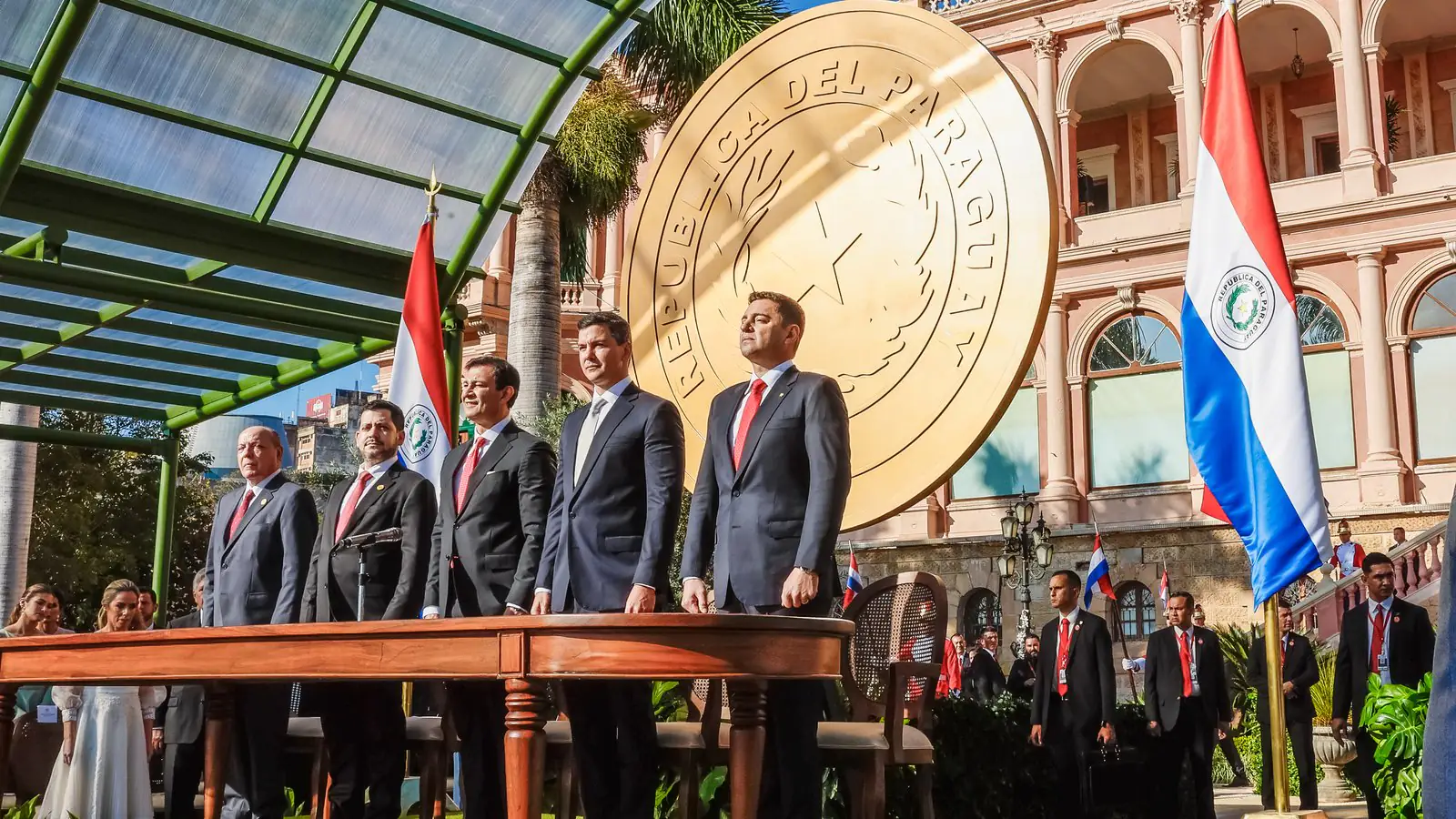
Photo: “15.08.2023 - Sessão Solene do Congresso da Nação para o juramento de Santiago Peña como Presidente da República do Paraguai e de Pedro Alliana como Vice-Presidente da República do Paraguai - 53119341808” by Lula Oficial, Wikimedia Commons, CC BY-SA 4.0, cropped to 16:9 and scaled to 1600x900 (WebP)
Elections have also held up. Paraguay voted for president in 1993, 1998, 2003, 2008, 2013, 2018 and 2023, always on the constitutional calendar. In 2008 Fernando Lugo's victory ended six decades of Colorado rule, and the handover went through without incident. The next scheduled handover is on 15 August 2028.
There is one external precedent worth knowing. After Lugo's removal, Mercosur suspended Paraguay on 29 June 2012 and only lifted the suspension when Horacio Cartes took office on 15 August 2013. The 2026 transition drew a different response: Uruguay recognized Alliana within two days, as Prensa Latina reported.
What a Change of Government Means for Your Residency
Residency in Paraguay rests on Ley N° 6984/2022, the migration law Congress passed under Mario Abdo Benítez. Its predecessor, Ley 978/96, stayed in force through the 1999 resignation and the 2012 impeachment without a single change triggered by either. A new president cannot amend a law by decree. Permits already granted and cédulas already issued remain valid until their normal expiry, whoever governs.
The softer layer is the executive one. The director of Migraciones is appointed by the government, and several recent rules arrived by resolution rather than by statute. The proof-of-income categories for permanent residency come from Resolución DNM 407/2026, explained in our guide to proof of income for residency, and the Investor Pass thresholds from a ministry resolution, compared in Investor Pass vs standard residency. A new government can revise instruments like these without Congress, and that is where to watch after any change at the top.
In practice the bigger effect of a political shock is time. New agency heads review files, signatures wait, and processing slows for a few weeks. If you are mid-application, the step-by-step cédula guide shows where the waiting points are, and building slack into those stages beats assuming the rules will change.
Planning a move despite the headlines? Our part is the residency procedure itself: the Migraciones file, the appointments and the cédula, handled on site with a Paraguayan partner lawyer. How much political risk you accept stays your call. Talk it through with us.
Where Paraguay's Politics Hits the Economy First
Political risk shows up in prices before it shows up in law. In the week of the 2026 crisis the dollar rose about 9% against the guaraní, to around ₲6,455, its biggest weekly gain since February 1998, according to Bloomberg Línea. JP Morgan's measure of country risk climbed from 119 to 144 basis points, after touching 157 on the day of the resignation, as our Ueno Bank follow-up records.
The rating agencies had put Paraguay on firmer ground before the shock. Moody's has rated the country investment grade (Baa3) since July 2024, and S&P raised it to BBB- in December 2025, giving Paraguay two investment-grade ratings for the first time. Whether either agency reacts to the 2026 events remains to be seen.
The banking side is where residents felt the crisis directly. About 2.94 million depositors had money at Ueno. By 7 November, interim central bank president Pedro Acosta said 1,196,000 of them had received ₲996 billion, about US$160 million, from the deposit guarantee fund, which was expected to repay 97% of depositors in full. Balances above the guarantee of 75 minimum wages per person and bank wait for the liquidation of the bank's assets.
How Residents Limit Political Risk in Paraguay
None of the steps below requires predicting politics. They reduce the damage if the next crisis arrives while you are mid-move.
- ▹Split your money across banks. The deposit guarantee applies per person and per bank, so two accounts at two institutions double the protected amount. The Ueno failure showed why a single local bank is a concentration risk. Our guide to opening a bank account in Paraguay lists the main options.
- ▹Keep your documents in two places. Store copies of your residency resolution, cédula, passport stamps and apostilled originals outside the country as well as at home. Re-issuing a lost document is slower when agencies are distracted.
- ▹Leave slack in your timeline. If a deadline depends on a government signature, plan for weeks of delay rather than days.
- ▹Stay away from protests at Congress. Demonstrations in Asunción concentrate around the Congress building and the Plaza de Armas, and both the 1999 and the 2017 protests turned deadly.
- ▹Register with your embassy. Most embassies run a registration scheme that sends alerts during unrest, and it costs nothing.
Who Should Weigh Paraguay's Politics More Carefully
For most residents the political cycle is background noise: a remote worker or retiree whose income comes from abroad and whose permit is already granted will notice a crisis mainly in the exchange rate. Three groups should look harder.
The first is anyone whose plan depends on discretionary state approvals, such as concessions, large public contracts or special tariffs, since those are negotiated with whoever governs. The second is a resident who keeps most savings in guaraníes at a single local bank. The third is an applicant on a tight deadline, for example a permanent-residency conversion window, who cannot absorb a few weeks of administrative delay.
If you fall into none of these groups, Paraguay's record since 1989 suggests the system will carry you through a change of government. If you do, the downsides of moving to Paraguay deserve a careful read alongside the advantages. For crime and day-to-day safety, which is a separate question from politics, see our guide to whether Paraguay is safe.
Frequently Asked Questions About Paraguay's Political Stability
Is Paraguay politically stable in 2026?
At the level of institutions, yes. The 2026 impeachment followed the constitutional procedure, the vice president took over the same day, and Congress filled the vice presidency within hours. At the level of individual leaders, less so: three presidents have been removed or pushed out since 1999.
Does a new president change Paraguay's residency rules?
Not directly. Residency is governed by Ley 6984/2022, which only Congress can amend. A new government can revise resolutions issued by Migraciones or ministries, such as proof-of-income rules or Investor Pass thresholds, and can slow processing while new officials take charge.
How many Paraguayan presidents have been removed from office since 1989?
Two were convicted by the Senate: Fernando Lugo in June 2012 and Santiago Peña in November 2026. A third, Raúl Cubas Grau, resigned in March 1999 while facing impeachment. In each case the constitutional successor took office immediately.
Who is Paraguay's president after the 2026 impeachment?
Pedro Alliana, the former vice president, sworn in on 6 November 2026 to complete the term ending on 15 August 2028. Congress elected Antonio Barrios, a physician and former health minister, as vice president the same day.
Is money in Paraguayan banks safe after the Ueno Bank failure?
Deposits are protected by a guarantee fund up to 75 minimum wages per person and per bank, and by 7 November 2026 about 1.2 million Ueno depositors had been repaid. Amounts above the cap depend on the liquidation of the failed bank, which is why spreading savings across banks is a sensible precaution.
When is Paraguay's next presidential election?
The next general election falls in 2028, with the new president taking office on 15 August 2028. Paraguay has held presidential elections every five years on the constitutional calendar since 1993, including after the 2012 impeachment.
The point of all this is proportion. Paraguay's political stability has bent several times without breaking, and the parts that govern a resident's legal status have held. If you want the residency side organized around that reality, see how our packages are structured.
Disclaimer: This article is general information, not legal, financial or political advice. Political conditions, migration resolutions and banking rules in Paraguay can change quickly, and the figures here reflect reporting up to 9 November 2026. Check current requirements with Migraciones or a Paraguayan lawyer before you act.
Sources on Paraguay's Constitution, Crises and Institutions
- ▹BACN: Constitución de la República del Paraguay (1992), Articles 225, 229 and 234
- ▹Senado de Paraguay: Pedro Alliana juró como nuevo presidente de la República (6 November 2026)
- ▹Emol / EFE / AFP: Senado de Paraguay destituye al presidente Santiago Peña (6 November 2026)
- ▹Bloomberg Línea: Dólar en Paraguay apunta a su mayor subida semanal en 28 años (6 November 2026)
- ▹France 24: Cómo sigue la devolución de fondos a clientes del Ueno Bank (7 November 2026)
- ▹Prensa Latina: Uruguay reconoce a nuevo presidente de Paraguay (8 November 2026)
- ▹Wikipedia: 1989 Paraguayan coup d'état
- ▹Wikipedia: Marzo paraguayo (1999)
- ▹Wikipedia: Impeachment of Fernando Lugo (2012)
- ▹AP via PBS NewsHour: Clashes, fire at Paraguay's Congress after re-election vote (1 April 2017)
- ▹Wikipedia: 2017 Paraguayan crisis
- ▹MercoPress: Mercosur will lift Paraguay's suspension on 15 August (12 July 2013)

About the author
Yannick Schroth
Founder · Paraguay relocation support
Spends regular time in Paraguay and, with his team on the ground in Asunción, guides international nomads, entrepreneurs and investors through residency, the cédula and the RUC paperwork.
Note: this article reflects the position at the time of publication. Laws, prices and deadlines can change, so individual details may since be out of date. Check the current rules before you act on them: we answer questions about residency and our services, while the tax treatment of your own case belongs with a qualified tax adviser.