Every checklist for moving to Paraguay tells you to bring proof of address. Almost none of them tell you what Paraguay counts as one. That gap is where people lose an afternoon at a counter, because the document they brought is perfectly good evidence in their home country and simply is not on the Paraguayan list.
The Four Documents Paraguay Accepts as Proof of Address
The Policía Nacional publishes the list for the Certificado de Vida y Residencia, and it is short:
| Document | What it is |
|---|---|
| Factura de ANDE | Bill from the state electricity utility |
| Factura de ESSAP | Water bill |
| Factura de COPACO | Bill from the state telephone company |
| Contrato de alquiler | Your rental contract |
That is the whole official list. A bank statement showing your address, a parcel label, a letter from an employer, a credit-card bill: none of them appear on it, so none of them can be counted on. A couple of informal alternatives are sometimes taken in practice, covered further down, but that comes down to an office's discretion rather than a rule.
Notice what the first three have in common. They are all state utilities. This is the detail that catches people, because most new arrivals get a mobile phone before anything else and assume the bill will do. Personal SIM contracts with private operators are not on the list. Only COPACO is, and COPACO is the fixed-line incumbent, not the network most people end up using. Do not plan around a phone bill.
The Certificado de Vida y Residencia, and Who Issues It
This is the document those four papers feed into, and it is worth understanding on its own because it appears in more processes than people expect.
It is issued by the comisaría jurisdiccional covering the address where you live, or alternatively by the Juzgado de Paz, the local justice of the peace. It is not something you order online or obtain centrally. You go to the police station for your own neighborhood, which means the address on the paper is the address they are attesting to.
What you bring: the request form, which the comisaría itself provides; a photocopy of the identity document of you and your witnesses; and one of the four documents above. Issuing takes a minimum of 24 working hours, and reports of 24 to 48 are common. At the comisaría it is free, though voluntary contributions are customary.
The Witness Rule Almost Nobody Mentions
Here is the part that is missing from essentially every relocation guide, and it is the part most likely to stall you.
You need witnesses who hold Paraguayan cédulas, and they have to turn up with the originals. Two is the number generally reported, and they are expected to be people who can plausibly confirm you live where you say you do, which in practice means neighbors rather than a friend across town.
Read that against the situation of someone who landed three weeks ago. You have a rental contract, you have an address, and you do not yet know two people in your barrio well enough to ask them to come to a police station on your behalf. Your landlord, a building administrator, or the neighbor you have spoken to are the realistic candidates. Nobody warns you to start building that relationship in week one, and it is a cheaper problem to solve early than urgently.
The Cédula Chicken-and-Egg Problem That Does Not Exist
A claim circulates that the Certificado de Vida y Residencia requires you to already hold a Paraguayan cédula, which would make it useless for anyone applying for their first one. Followed literally, that would make the cédula process impossible.
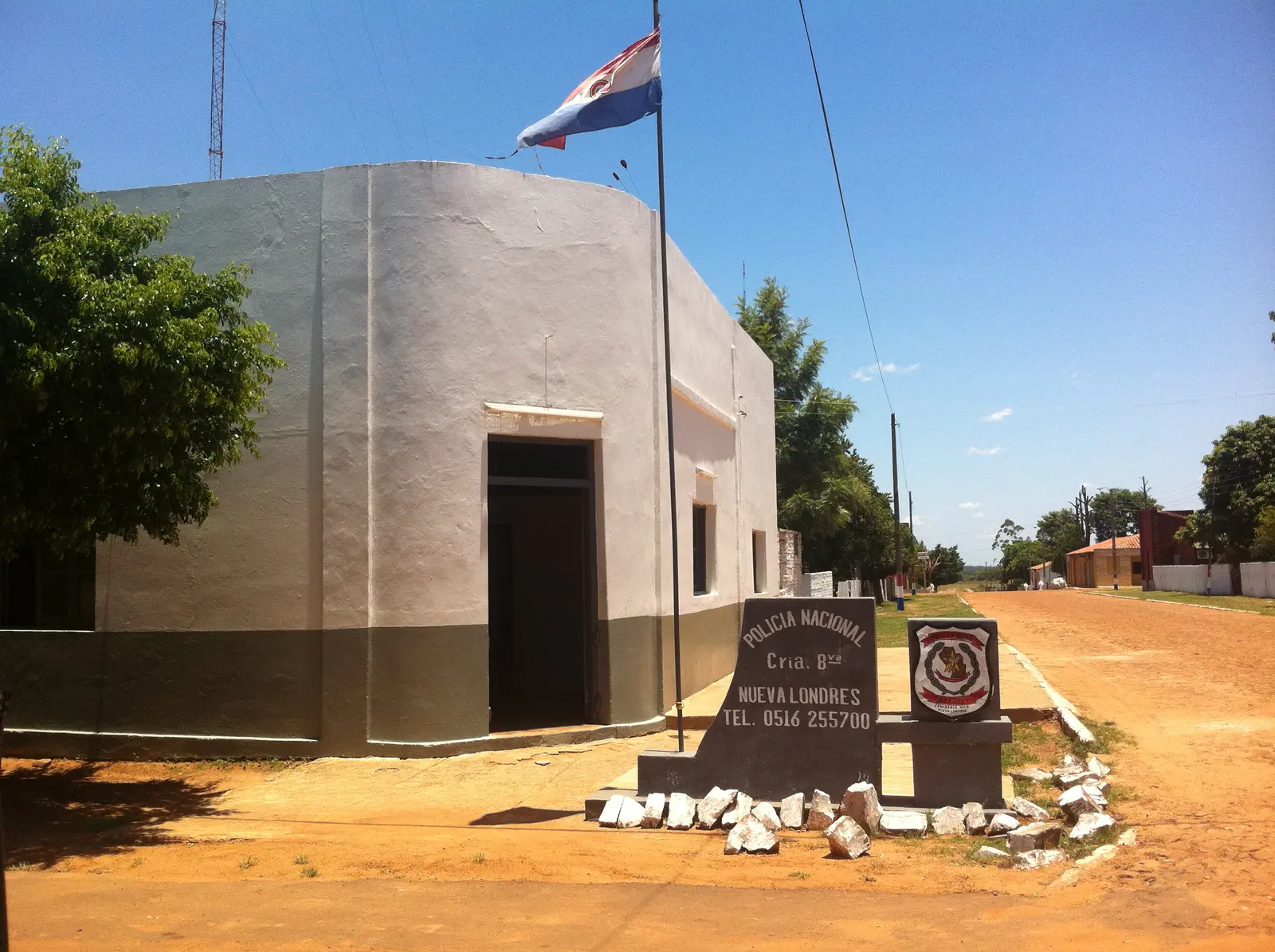
Photo: “Comisaria 8va. Policia Nacional Nueva Londres - panoramio” by Va de Carro, Wikimedia Commons, CC BY 3.0, scaled (WebP)
The sequence runs the other way. Under Resolución 717/2026, the certificate is one of the ten documents a foreigner submits in order to obtain the first cédula, listed as an original from the local comisaría or the Juzgado de Paz. For applicants who have no Paraguayan cédula yet, the accepted identity document is the passport.
The confusion is traceable to the wording of the requirement itself, which asks for the identity document "of the applicant and of the witnesses". The witnesses are the ones who must produce Paraguayan cédulas. The applicant does not. If you have been told the certificate is out of reach until you have your cédula, that is a misreading of a single line, and it sends people looking for a workaround to a problem they do not have.
What Counts Before Any Utility Is in Your Name
The four-document list assumes an established household. New arrivals rarely have one: the electricity account is still the landlord's, and it usually stays that way for the whole tenancy.
In practice three things carry the address at this stage, and only the first is on the official list. Your rental contract, even a short or furnished one, is the cleanest. A notarized confirmation from the landlord, at roughly $10 to $40, is often taken where the contract is informal, and a booking confirmation from Airbnb or a hotel that shows the address is, in our cases, usually enough for newcomers who have not signed a lease yet.
Neither of those two is on the official list, so an officer can still ask for more, but you do not need a lease just to get started.
Our guide to renting an apartment covers getting a contract that is usable as a document and not only as a tenancy.
The Fiscal Address and the Sketch Map
Registering for a RUC, the tax number, adds a requirement people find surprising. Alongside the comprobante de domicilio fiscal, DNIT wants a croquis: a sketch showing where the address is. A screenshot from Google Maps is enough. It is not a formality invented to obstruct you; addressing in Paraguay is less systematic than street numbering suggests, and the sketch is how the file becomes findable. The wider registration sequence is in our RUC and tax filing guide.
One consequence worth planning around: your address is printed on the cédula card itself. Move, and the card no longer matches where you live, which means an update rather than a simple change of correspondence details. If you expect to move within your first year, and most people do once they know the city, it is worth knowing that the first address you register is not free of consequences.
How Long Is a Proof of Address Valid?
There is no single published rule, and anyone quoting you a firm number is filling a gap with confidence rather than a source. Institutions set their own expectations, and a recent bill is always safer than an old one. The practical approach is to obtain the document close to the appointment rather than early, which is the opposite of the advice for apostilled home-country papers.
For those, we suggest filing the police record within 90 days of the date it was issued, a recommendation of ours rather than a period Migraciones publishes, and slow apostilles eat into that margin.
What This Means for Your Move
Proof of address is an administrative detail, not a legal threshold, and it does not change your tax position in either direction. Paraguay taxes on the territorial principle: what matters is where income arises, and genuinely foreign-source income stays, in principle, outside the local income tax for a real resident. An ANDE bill does not create a tax liability, and its absence does not remove one.
What it does affect is whether your file moves. The cédula, the RUC and a bank account all want an address that a Paraguayan institution can verify, which is the recurring theme of the first thirty days. Sort the address document, a rental contract or for now an Airbnb booking, get on speaking terms with two neighbors, and this stops being a story.
US citizens and green-card holders: none of this changes your position with the IRS. The United States taxes worldwide income on the basis of citizenship, so a Paraguayan address, a cédula and a RUC leave your US filing obligations exactly where they were. The mechanics are in our guide for US persons.
Frequently Asked Questions About Proof of Address in Paraguay
Can I use my mobile phone bill as proof of address in Paraguay?
Do not count on it. The official list names ANDE, ESSAP and COPACO, all state utilities, plus the rental contract. COPACO is the fixed-line operator, not the mobile network most people sign up with. A private mobile contract is not on the list, and whether anyone accepts it is discretion rather than rule.
Do I need a cédula to get the Certificado de Vida y Residencia?
No. The certificate is one of the documents required for the first cédula under Resolución 717/2026, and a foreign applicant presents a passport. The Paraguayan cédulas that must be produced are the witnesses', not yours.
Can I prove my address in Paraguay if the electricity account is in my landlord's name?
That is the normal situation and it is why the rental contract is on the list in its own right. Where the contract is informal, a notarized confirmation from the landlord, roughly $10 to $40, is the usual fallback, but it is not on the official list and each office decides whether to take it.
Can I use an Airbnb booking as proof of address in Paraguay?
Usually, yes. For newcomers still in short-term accommodation, an Airbnb booking confirmation that shows the address has in our cases been enough for the residency file. It is not one of the four documents on the official list, so the officer on duty has the final word, and a signed lease later removes the question.
Where do I apply for the Certificado de Vida y Residencia?
The comisaría covering the neighborhood you live in, or the local Juzgado de Paz. Not a central office, and not online. Bring the form, the identity documents for yourself and your witnesses, and your address document. Allow at least a full working day.
Not sure which of these your own situation needs? The list is short, but the order you do things in decides whether you spend one morning on it or three. Ask us how our packages handle the proof-of-address step for the residency file.
Disclaimer: General information on Paraguayan administrative practice, not legal advice. Requirements are applied by individual offices and can vary by comisaría and by the officer on duty, and the Policía Nacional's published requirement list carries its own revision date. The Paraguayan police website was unreachable from outside the country while this was written, so the requirement list here rests on the published official list as reproduced by Paraguayan outlets and specialist practices rather than on a live reading of the source. Confirm current requirements locally before you file.
Sources
- ▹Policía Nacional: requisitos del Certificado de Vida y Residencia para extranjeros
- ▹ABC Color: Los diez requisitos para la cédula de identidad paraguaya de extranjeros (Resolución 717/2026)
- ▹Policía Nacional, Dpto. Identificaciones: cédula por primera vez a extranjeros
- ▹Más Encarnación: requisitos del certificado de vida y residencia

About the author
Yannick Schroth
Founder · Paraguay relocation support
Spends regular time in Paraguay and, with his team on the ground in Asunción, guides international nomads, entrepreneurs and investors through residency, the cédula and the RUC paperwork.
Note: this article reflects the position at the time of publication. Laws, prices and deadlines can change, so individual details may since be out of date. Check the current rules before you act on them: we answer questions about residency and our services, while the tax treatment of your own case belongs with a qualified tax adviser.