Two years after your first carnet, Migraciones asks a question it skipped the first time: what do you live on? The answer has to come as proof of income in one of twelve categories, each with its own papers, and since 6 July 2026 a diploma or a bank balance no longer does the job. Resolución DNM 407/2026 sets no minimum amount. What it demands is evidence that the income exists, that it is current and that it matches the activity you declared when you arrived.
The rules come from the resolution itself, signed in Asunción on 28 May 2026 by the national migration director, and from the requirement sheets Migraciones published on 1 July 2026. Below you will find every category, the exact document each one names, and the points where the text is narrower or vaguer than most summaries suggest.
Proof of Income for Paraguay Residency: What Resolución 407/2026 Requires
Paraguay asks for proof of income only at the permanent stage. Your temporary residency application needs none; the change to permanent residency after two years does. The resolution calls it acreditación de solvencia económica and makes it a condition of admission: you must show medios de vida lícitos, suficientes y verificables, lawful means of living that are sufficient and can be checked.
The text is blunt about one point. Solvency "may not be presumed in any case." The documents have to evidence either the effective generation of income or the real availability of economic resources, and they are read against the profession or activity you declared when you filed for temporary residency.
Four conditions apply to every proof of income, whatever the category. The documents must be coherent with the activity you declared, unless you prove a change. They must allow the income to be verified objectively. They must be current. And anything issued abroad must be legalized or apostilled and, where needed, translated into Spanish. Migraciones can always ask for more.
The legal basis is the migration law, Ley 6984/2022, Articles 78, 79 and 82, together with Ley 3565/08, which approved the Mercosur Residency Agreement. The resolution replaced the solvency annexes of two older resolutions, 710/2024 and 905/2024, which had been amended four times between them.
Proof of Solvency at a Glance: The Twelve Categories
Each category carries its own evidence, and the table is the short version. None of them names a figure in dollars, guaraníes or minimum wages.
| Category | Core proof of income | Easy to miss |
|---|---|---|
| 1. Professionals | Degree registered with the MEC plus IPS record, labor contract or tax returns | The degree alone is not enough |
| 2. Technicians | Technical diploma registered with the MEC plus the same evidence | Same rule as professionals |
| 3. Employees | IPS insured-person record or a labor contract registered with the labor ministry | Remote staff of foreign firms use category 5 |
| 4. Self-employed (trade and services) | RUC registration plus IVA returns for 3 months or the IRP return for the last year, with a tax compliance certificate | Returns must show real activity |
| 5. Remote workers and digital nomads | Work certificate stating the relationship, income and how you are paid | Apostille and translation |
| 6. Property owners | Title registered with the national registry (RUN) | Proof of income from the property can be requested |
| 7. Shareholders and partners | Registered company deed or share register naming you; for an EAS, the DGPEJBF certificate | No minimum stake |
| 8. Farmers and ranchers | Productive land title or sales records or a registered brand, plus tax certificates | Tax compliance is required |
| 9. Religious workers | MEC registration of the congregation plus its letter covering your costs | The congregation carries the costs |
| 10. Retirees and pensioners | Pension certificate showing the amount and the payment channel | Legalized or apostilled |
| 11. Dependants | Marriage or family-link documents plus the supporter's Paraguayan ID or carnet | Covers spouses, parents, grandparents, persons with disability |
| 12. Students (18+) | Enrolment and payment records for the two temporary years, plus own income or family support | Student status alone fails |
Children under 18 sit outside the twelve. The Migraciones requirement sheet places them in a separate category, Niños, Niñas y Adolescentes, which is exempt from proving solvency because the parents or legal guardians carry the economic responsibility.
When Paraguay Asks for Solvency, and the Filing Window
The temporary application does not ask for solvency, but it does ask you to declare, under oath, the activity you will carry out in Paraguay. That declaration matters two years later. The resolution measures your permanent file against it, so a first application that says "digital nomad" and a permanent file built on a local labor contract invites questions unless you document the change.
The window is tight. You file the change of category within the three months before your temporary carnet expires. Up to one month after expiry you can still file, with a fine for overstaying. After that only an extension of the temporary residency is possible, up to six months after expiry and again with a fine.
The permanent residency fee is Gs. 2,926,925, 25 daily minimum wages under Resolución DNM 478/2026, roughly US$500 at current rates. Recording a change of personal data, including a new profession, costs a further Gs. 234,154. The full cost picture, with translations and certificates, is in our residency cost breakdown.
Professionals and Technicians: A Diploma Is No Longer Proof of Solvency
Under the requirement sheet Migraciones published in July 2025, a university degree was enough for the professional category. That route is closed. The resolution says it outright: "the mere possession of the professional title shall not constitute sufficient proof of economic solvency."
A professional now files the degree, registered and stamped (registrado y visado) by Paraguay's Ministry of Education and Science (MEC), plus an authenticated copy of one of three documents that prove the profession is practised and produces income.
There are three options: an IPS insured-person certificate, a labor contract stamped, approved and registered by the Ministry of Labor, or tax returns: IVA declarations for the last three months or the IRP return for the last year, together with a certificate of tax compliance, and the returns have to show movement.
Technicians follow the same structure with a technical diploma (título de tecnicatura) registered with the MEC. For both, the second document is what carries the weight. A foreign degree that has never been used to earn anything in Paraguay will not stand as proof of income on its own.
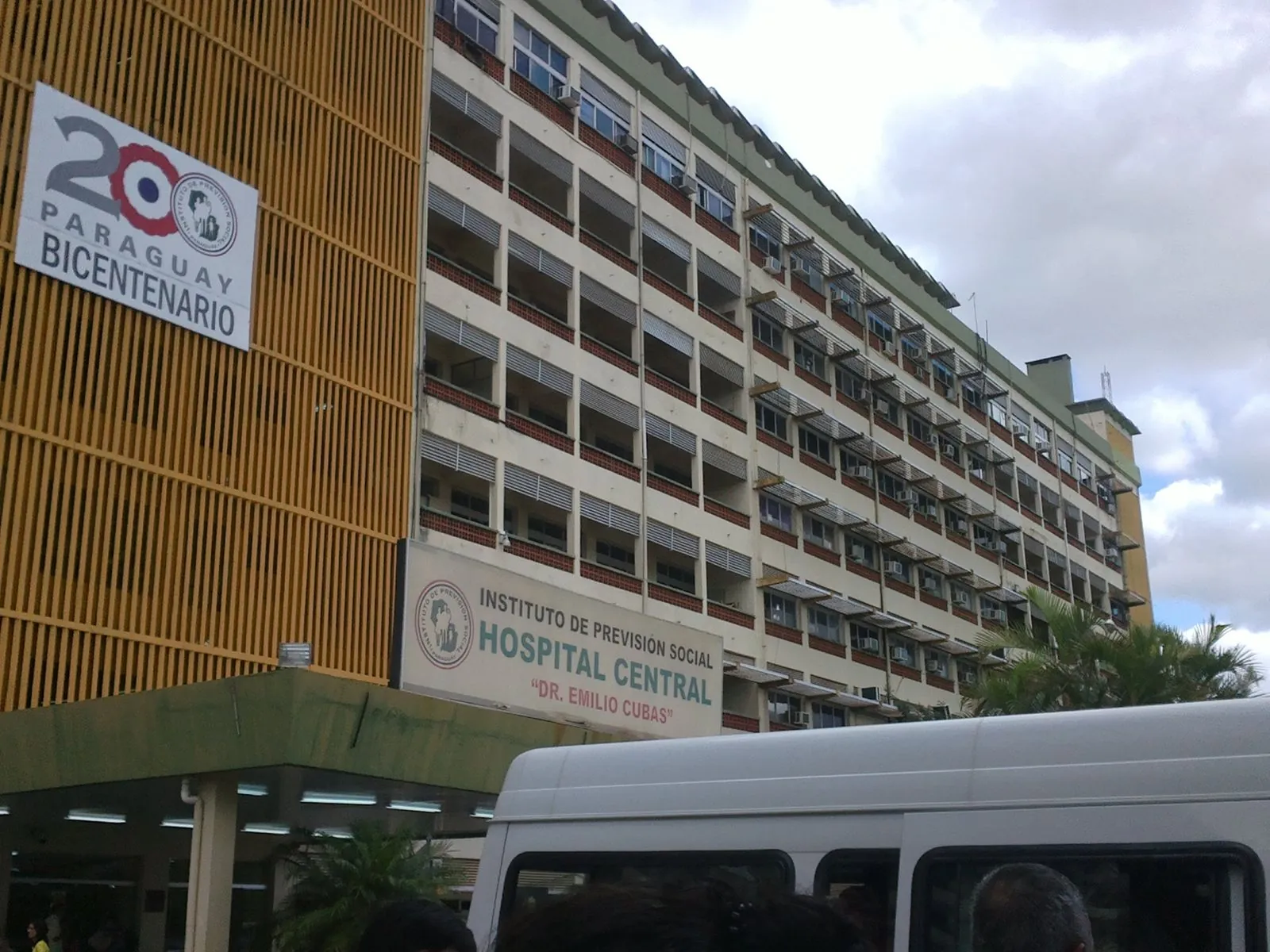
Photo: “Ips instituto de prevision social hospital” by Iamlatin, Wikimedia Commons, CC BY-SA 3.0, scaled to 1600 px (WebP)
Employees and the Self-Employed: IPS, Labor Contracts and the RUC
Employees have the simplest file in the resolution. Either an IPS certificate showing that you are insured through your employer, or a labor contract stamped, approved and registered by the Ministry of Labor (MTESS). Both prove an employment relationship inside Paraguay. Someone working for a foreign company from a laptop in Asunción has neither, which is why such people belong in the remote-worker category instead.
The self-employed category, trabajadores independientes in trade and services, asks for two things. First the Constancia de Persona Física, the proof that you are registered as a taxpayer with a RUC. Second, IVA declarations for the last three months or the IRP return for the last year, plus a certificate of tax compliance, "having to demonstrate the movement".
The text sets no minimum age for the RUC, despite claims you may read elsewhere. In practice, though, three monthly returns with real turnover only exist after months of trading, and a compliance certificate requires your filings to be up to date. A RUC opened weeks before the appointment rarely produces either. Completing the RUC also means appearing in person at a DNIT office; any office in the country works, not only Asunción. Our RUC and tax filing guide covers that step.
Remote Workers and Digital Nomads: One Certificate, Three Facts
The remote-worker category is the one most foreign applicants land in, and its requirement is short. You file a work certificate (certificado o constancia de trabajo) that has to establish three facts: the working relationship, the income you receive, and the channel through which your fees or salary reach you. Documents issued abroad must be legalized or apostilled and translated into Spanish.
The wording covers honorarios o salario, fees or salary, which reads as including contractors paid by clients as well as employees. That is our reading of the text, not an official interpretation. The resolution does not ask for a set number of bank statements, a minimum monthly income or a contract of a particular length. Migraciones may still request additional evidence, and a certificate whose figures cannot be traced to real payments is exactly what the verification rule targets.
One drafting detail is worth knowing. In the signed resolution the remote-worker list has a single item that ends with "; or", and no second option follows. The published requirement sheet drops the dangling "or". Do not plan around an alternative the text never states. Our digital nomad guide covers the rest of the remote-worker route.
Preparing the change to permanent residency? We coordinate the file, the appointments and the translations. Which solvency category fits your situation is confirmed by our partner lawyer and by Migraciones itself. See the permanent residency service.
Property Owners and Shareholders: Assets as Proof of Solvency
For someone without an employer or a local business, two asset categories are the usual answer, and neither sets a minimum value. A property owner files the title deed registered with the Dirección General de los Registros Públicos, today the Registro Unificado Nacional (RUN), "con registro previo en los últimos dos (2) años". Migraciones may also request documents showing income generated by the property.
That two-year phrase is ambiguous. It can be read as a registration at least two years old or as one made within the last two years, and several summaries present one reading as settled. Neither has been confirmed by Migraciones in a public statement, so ask before you rely on a recent purchase. The practical side of buying is in our property buying guide.
Shareholders file an authenticated copy of the company's deed of incorporation registered with RUN that names them as shareholders, or the company submits its registered share register or an electronic certificate naming them. For a simplified joint-stock company (EAS), the proof is the certificate of the Dirección General de Personas y Estructuras Jurídicas y Beneficiarios Finales. No minimum shareholding or capital appears. Setting up such a company is covered in our company formation guide.
The Paraguay Investor Pass is a separate route. It grants permanent residency directly against a qualifying investment and does not run through the change of category described here.
Retirees and Pensioners: The Pension Certificate as Proof of Income
A retiree or pensioner files a pension certificate (constancia de jubilación o pensión) that states the amount received and the financial channel through which it is paid. The resolution adds that the documents must be duly legalized or apostilled, and the general rule on Spanish translation applies to anything issued in another language.
There is no minimum pension in the text. That surprises people who have read about pensioner programs in Panama or Costa Rica, which work with fixed monthly thresholds. Paraguay has no separate retiree visa of that kind; the retiree category is one of the twelve ways to prove solvency within the ordinary route, as our guide to the Paraguay pensionado question explains in more detail.
What makes a pension file work is the payment trail. A certificate that names the amount and the bank account it lands in lets an official connect the document to real money, which is the test the whole resolution is built around.
Photo: “Facultad de Ciencias Sociales de la Universidad Nacional de Asunción” by Dani O S, Wikimedia Commons, CC0, scaled to 1600 px (WebP)
Dependants, Spouses and Students in Paraguay's Solvency Rules
The dependants category covers three situations. A spouse supported by the other spouse files a legalized or apostilled marriage certificate and an authenticated copy of the partner's Paraguayan cédula or residence carnet. Parents or grandparents supported by their children or grandchildren file a document proving the family link and a copy of the supporter's Paraguayan ID or carnet. A person with a disability supported by a parent, grandparent, sibling, uncle or aunt adds a disability certificate from SENADIS or the competent authority of the home country.
Note the direction of the family route. It runs from children to parents, not the other way round. An adult child supported by parents has no dependant category of their own; the student category, with proof of family support, is the one written for that situation. Anyone who declared "homemaker" (ama de casa) at the temporary stage is moved to the dependant category by Migraciones without charge and files the dependant documents.
Students must be 18 or older and enrolled in school, a university or a higher institute, in person in Paraguay or remotely while living here. They file proof of regular enrolment, proof of academic continuity and payment receipts or school records covering the two years of temporary residency.
Student status alone does not count as solvency. A student also shows their own income or support from a close relative, with the family link, a copy of the supporter's ID and proof of real transfers or deposits. Families can plan this with our guide to moving with children.
Farmers, Ranchers and Religious Workers in Paraguay
Two categories are narrow but complete the list. Farmers and ranchers choose between two options. One is a title to land used for production, registered with RUN, plus the tax compliance certificate and the Constancia de Persona Física. The other is a document proving the purchase or sale of their production, or a registered brand for it, plus the tax compliance certificate.
Religious workers file a certificate from the MEC showing that their congregation is registered, and a letter from the congregation or entity certifying the role and stating that it covers the costs of the stay. Here the institution, not the individual, carries the economic burden.
How Migraciones Assesses Your Proof of Income
The resolution tells officials how to read a file, and two rules work in the applicant's favor. Assessment is integral, both at the counter and during processing, guided by the principles of informality, reasonableness, good faith and acting on the authority's own initiative. If your documents show your real situation better under another category, the official must reclassify the file into the most suitable one rather than reject it.
The counterweight is just as clear. Migraciones may verify any document, ask for more information and deny the application where solvency is not convincingly proven. Every residency application, temporary or permanent, has the character of a sworn statement, and signs of falsehood lead to administrative measures and, where applicable, referral to the public prosecutor.
The resolution applies equally to permanent residency under the migration law and under the Mercosur agreement. Mercosur applicants follow the same twelve categories and must file from 90 days before their temporary card expires, or they lose the Mercosur route. Translations must come from a translator registered in Paraguay, or from a sworn translator abroad whose translation is then apostilled or legalized; Portuguese documents from Brazil are exempt.
One visible change sits on the card itself. The new permanent carnet no longer prints your profession or solvency category. Both remain recorded in the Migraciones system and in the resolution granting your residency.
Old Rules Versus the 2026 Proof of Income Rules
The requirement sheet Migraciones published in July 2025 accepted shortcuts that the 2026 rules removed. A degree alone qualified a professional. A single dependant could file a certificate from a Paraguayan bank account or a notarized sworn maintenance declaration. A merchant could submit a balance sheet certified by an accountant. None of these appears in Resolución 407/2026, and its recitals say why: the old criteria were scattered across amended annexes, and professionals in particular needed a closer link between declared activity and real income.
The errors that follow from this are predictable. Filing a degree without a second document. Assuming a savings balance counts on its own, when no category names it. Building a permanent file on an activity that contradicts the temporary declaration. Opening the RUC too late for the returns to show movement. And translating a foreign document before it was apostilled, so the translation covers a paper the office will not accept.
US citizens and green-card holders: whichever category proves your solvency, residency in Paraguay does not end US tax obligations. The United States taxes citizens and green-card holders on worldwide income regardless of where they live, and the IVA or IRP returns a self-employed applicant files here sit on top of that. Our guide for US persons explains the overlap.
Frequently Asked Questions About Paraguay Residency Proof of Income
Is there a minimum income for Paraguay permanent residency?
No. Resolución DNM 407/2026 sets no figure in dollars, guaraníes or minimum wages for any of its twelve categories. It requires lawful, sufficient and verifiable means of living, proven with current documents that fit your declared activity. Migraciones judges sufficiency case by case and may ask for additional evidence.
Do I need proof of income for Paraguay temporary residency?
No. The resolution limits the solvency proof to permanent residency and leaves temporary requirements unchanged. The temporary application does include a sworn declaration of the activity you will carry out, and your permanent proof of income is later checked against that declaration, so choose it carefully.
Can digital nomads use bank statements as proof of income in Paraguay?
The remote-worker category names a work certificate, not bank statements. It must state the working relationship, the income received and the channel through which fees or salary are paid, legalized or apostilled and translated. Bank records can support the certificate if Migraciones asks for more, but they do not replace it.
Does a savings balance count as proof of solvency for Paraguay residency?
Not on its own. None of the twelve categories accepts a bank balance by itself, and the 2025 option of a Paraguayan bank-account certificate for single dependants is gone. Someone living from capital usually qualifies as a property owner, a shareholder or a retiree, each with its own documents.
Is there an independent means visa for Paraguay residency?
No. Paraguay has no rentista or independent-means visa with a fixed income threshold. Everyone takes the ordinary route of temporary then permanent residency, and at the permanent stage proves solvency in one of twelve categories. The Investor Pass is a separate route to direct permanent residency through a qualifying investment.
Do children need proof of income for Paraguay residency?
No. Applicants aged 0 to 17 fall into the separate category of children and adolescents, which Migraciones exempts from the solvency proof because parents or guardians carry the economic responsibility. Their files still need the parents' signatures and, depending on the situation, a court order or notarized consent.
Can I change my solvency category between temporary and permanent residency in Paraguay?
Yes, if you document the change. The resolution reads your permanent file against the activity you declared at the temporary stage, unless an update is duly proven. You file the document showing the new profession or occupation and pay Gs. 234,154 for recording the changed data.
Do Mercosur citizens need proof of income for Paraguay permanent residency?
Yes. Resolución 407/2026 applies the same twelve categories to permanent residency under the Mercosur Residency Agreement, approved in Paraguay by Ley 3565/08. Mercosur applicants must also file from 90 days before their temporary card expires, otherwise they lose access to the Mercosur route.
Two years go by quickly, and the proof of income is the part of the permanent file that needs the longest run-up. Tell us your planned dates and we will set out the timeline from temporary carnet to permanent residency, including the point at which your category's documents should be ready.
Disclaimer: This article is general information about Paraguayan migration rules, not legal, immigration or tax advice. Requirements can change and are applied case by case; Migraciones may request additional documents. Confirm the current requirements for your category with Migraciones or a qualified lawyer before you file.
Sources
- ▹Resolución DNM N.º 407/2026 of 28 May 2026, signed text with annex (Migraciones PDF, archived copy)
- ▹Migraciones requirement sheet, permanent residency for the change of category, 1 July 2026 (archived copy)
- ▹Migraciones requirement sheet, Mercosur permanent residency (archived copy)
- ▹Migraciones press release on the new solvency regime, 25 June 2026 (archived copy)
- ▹Migraciones fee schedule under Resolución DNM 478/2026 (archived copy)
- ▹ABC Color: Cambios para acceder a la residencia permanente en Paraguay, 25 June 2026
- ▹Ley 6984/2022 de Migraciones (BACN)

About the author
Yannick Schroth
Founder · Paraguay relocation support
Spends regular time in Paraguay and, with his team on the ground in Asunción, guides international nomads, entrepreneurs and investors through residency, the cédula and the RUC paperwork.
Note: this article reflects the position at the time of publication. Laws, prices and deadlines can change, so individual details may since be out of date. Check the current rules before you act on them: we answer questions about residency and our services, while the tax treatment of your own case belongs with a qualified tax adviser.