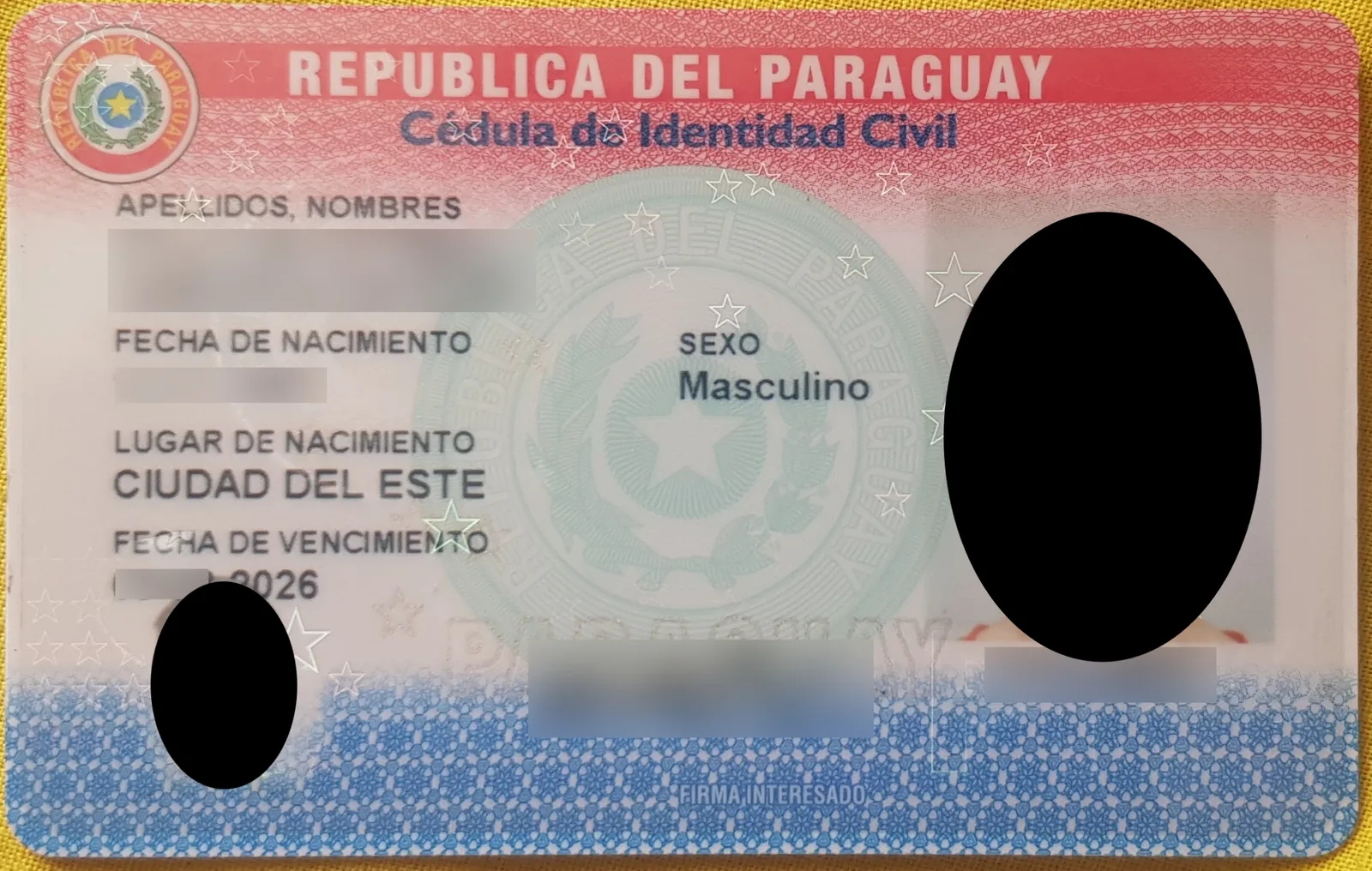
You have decided Paraguay is the plan — the territorial tax system, the low cost of living, the long-run path to citizenship. Now you face the part nobody makes glamorous: the documents, the apostilles, the trip to Migraciones, and the small plastic card at the end of it, the cédula.
This guide takes Paraguay residency and the cédula step by step, with the 2026 rule changes built in, so you know exactly what to gather, what to translate, what it costs, and how the timeline runs from temporary residency to permanent residency to citizenship.
The high-level path looks like this:
- ▹Gather your documents: birth certificate, plus a police record from every country you have lived in for more than twelve months in the last three years, not only your home country.
- ▹Apostille and translate: apostille both, then have them sworn-translated into Spanish in Paraguay.
- ▹File at Migraciones: submit your temporary-residency application with a statement of the activity you plan to pursue; no proof of means is needed yet.
- ▹Get your cédula: obtain the Paraguayan ID card in person.
- ▹Build your solvency evidence: prepare the proof your category needs for the permanent application.
- ▹Upgrade to permanent residency: file in the window from month 21 to month 24 of temporary residency.
- ▹Apply for citizenship: when permanent status has run for three years, about five years after you first filed.
I know this process first-hand, and our team on site accompanies applicants through it, so the guide below is the practical version, including the mistakes that cost people an extra trip.
One thing up front: the cédula is issued in person, so the standard route means two visits to Paraguay and five to seven months to the card. The one-trip version, three to four months to the cédula, comes from the Premium route, where the cédula biometrics are taken on the first visit and the cédula fast-track shortens the wait after the carnet.
What Paraguay Residency and the Cédula Actually Get You
Paraguay residency is your legal right to live in the country, and the cédula (cédula de identidad) is the physical ID card that proves it. With residency and a cédula you can open bank accounts, sign leases and contracts, register a vehicle, access services, and build the local footprint that supports genuine tax residency. It is the platform on which everything else (banking, tax residency, eventually citizenship) is built.
What residency does not do by itself is make you tax-free. Legal residency and tax residency are different things: the cédula is your immigration status, while Paraguayan tax residency is a separate question under Paraguayan tax law, one a local contador can clarify for you. The two work together but are not the same, a distinction I unpack in the guide to Paraguay tax residency and 0% territorial tax. Treat the cédula as the starting line for the tax benefit, not the finish.
The end prize for many is the passport. Paraguayan citizenship, reachable after a few years of legal residency, brings a passport with visa-free or visa-on-arrival access to 140+ countries. That combination of accessible residency, a real path to citizenship, and a territorial tax system is why tax-motivated entrepreneurs and nomads take Paraguay seriously despite the bureaucracy.
Temporary vs Permanent Residency in Paraguay: The 2026 Path
Paraguay's residency framework under Ley 6984/2022 runs in two stages: you first obtain temporary residency, which lasts two years, and then seek conversion to permanent residency in a window that opens in month 21 and closes at the end of month 24. Going straight to permanent residency is reserved for investors using the Investor Pass and for the husbands, wives and children of Paraguayans under Ley 2193/2003; nomads, freelancers and retirees all start on temporary residency.
Temporary residency already gives you a cédula and the practical rights you need: banking, leasing, and a local tax ID. Permanent residency then replaces the two-year limit with indefinite status and strengthens your standing, and it is the base from which the citizenship clock is usually counted. The upgrade is a further application with its own documents and fees rather than an automatic rollover, so treat it as a scheduled task, not a formality that happens on its own.
For 2026 specifically, two changes matter, and it is worth knowing which stage each one hits. A solvency regime was introduced under Resolución DNM 407/2026 (applications filed from 6 July 2026), and it governs the permanent-residency application, not the temporary one. Updated Migraciones fees arrived under Resolución DNM 478/2026 (effective 1 July 2026) and apply at filing. Both are recent, so the exact figures and document lists are a moving target. The steps below hold, but verify current amounts before you file.
Step 1: Gather Your Documents for Paraguay Residency
The two core home-country documents are a birth certificate and a police record (a criminal-background / good-conduct certificate). These are the backbone of every Paraguay residency application. Order recent copies (many offices expect them to be issued within the last few months) and get them in the correct official form your country uses for international purposes.
Depending on your situation, you may also need a marriage certificate (if applying with a spouse or using married status), documents for each child (every child needs its own application, and from age 14 its own police record), and a copy of your passport, valid for at least six months when you apply (twelve is safer). Where a marriage certificate applies, request a separate copy for each spouse; one document issued for the couple will not cover both files.
If you want the residency done in a single trip, choose that route now, because it changes how the appointments are scheduled. The one-trip version is the Premium package: the cédula biometrics are grouped into the first visit, and the cédula fast-track cuts the gap after the carnet to a few days. Premium also covers the RUC inscription, but the RUC itself completes only after the cédula exists, with you in person at a DNIT office, which can be any office in the country.
A word on sequencing: gather everything before you fly. The single most common cause of a wasted trip is arriving with a document missing, expired, or in the wrong form, and discovering it only at the Migraciones counter. Build a checklist, confirm it against current requirements, and do not assume last year's list still applies in 2026.
Step 2: Apostille and Sworn Spanish Translation of Your Documents
Every foreign document has to be legalized and translated. If your country is party to the Hague Apostille Convention, your birth certificate and police record each need an apostille (a standardized certification that makes the document valid abroad) obtained in the issuing country before you travel. If your country is not part of the convention, you will go through consular legalization instead, which is slower, so start early.
Once apostilled, the documents must be translated into Spanish by a sworn public translator (traductor público matriculado) in Paraguay. This is not a job for an online translation service or a bilingual friend, because Paraguayan authorities require the translation to carry the seal and registration of an officially matriculated translator. In practice you bring the apostilled originals to Paraguay and have the sworn translation done locally, which is fast and inexpensive.
Planning your Paraguay residency? A short intro call explains how the filing in Paraguay runs and how long each stage takes. Get in touch.
One document catches people out, and it is worth its own paragraph. Migraciones looks back over the last three years, which is not the same as one certificate from the country on your passport. If you were resident somewhere else for more than twelve months in that window, that country's police certificate is wanted too, each one apostilled in the country that issued it, and you must also document how long you lived there. Applications have been turned away at the counter for exactly this gap.
The clock is the second half of the trap, and it is worth being precise about who sets it. Migraciones asks for a certificate that is vigente, meaning current, and publishes no number of days; plenty of relocation sites quote 90 days as though it were the rule, and it is not. What the deadline actually depends on is the validity your own issuing authority prints on the document, which differs from country to country.
Our recommendation is to keep it under 90 days at submission, counted from the day it was issued rather than the day it was apostilled. That is a safety margin, not a regulation. Order the certificate, wait weeks for the apostille, and you can land in Asunción holding a document that is already half spent. Where an apostille is slow, start it early and time the certificate to the appointment rather than to your flight.
The order matters: apostille first in your home country, then translate in Paraguay. Translating before apostilling is a classic misstep, because the apostille itself is part of what gets translated and validated. Get the sequence right and this step is smooth; get it backwards and you redo the translation.

Step 3: File Your Residency Application at Migraciones
With apostilled, sworn-translated documents in hand, plus the declaración jurada, a sworn statement describing what you will do in Paraguay, you file the temporary-residency application with the Dirección Nacional de Migraciones. No proof of income or funds belongs in this first file. This is where fees are paid, currently 25 jornales mínimos (₲2,926,925, about $500 at roughly 5,870 Gs to the dollar at the end of September 2026) for temporary residency under Resolución DNM 478/2026, and where your file is formally opened.
The same fee falls due again later for the permanent application. Expect this to be a bureaucratic experience. Migraciones moves at its own pace, queues are real, and having a local representative or lawyer who knows the current counter-level requirements saves time and repeat visits. This is one area where doing it entirely solo, in Spanish, without knowing the latest procedural quirks, tends to cost more in wasted trips than professional help costs in fees.
In-country steps typically include an Interpol Paraguay clearance and a local police records check (antecedentes), which is why the process cannot be completed entirely from abroad. Once filed, your application is processed and the residency card (carnet) is issued, typically three to four months later on the standard route; the cédula follows. Because the sequence involves local checks and in-person steps, budget realistic time on the ground rather than assuming a single short visit will close everything out.
Step 4: Get Your Paraguay Cédula in Person
The cédula is issued in person at the Departamento de Identificaciones, where you appear, provide biometrics (photo, fingerprints), and collect the card. This in-person requirement is why the standard process takes two trips: one to file and complete residency steps, another to obtain the cédula once residency is approved, with the card arriving one to two months after the carnet and five to seven months from the start.
A single trip works only when it is planned that way from the outset. On the Premium route the cédula biometrics are taken during the first visit and the fast-track has the card ready a few days after the carnet, three to four months in total. The RUC (local tax ID) is a separate step that completes only after an in-person DNIT visit once the cédula is in hand, and you attend that one yourself, at whichever DNIT office suits you.
Ignore any marketing that promises the entire process "in one trip, done from your sofa." The cédula's biometric, in-person nature makes that impossible as a rule. Plan for the reality of two visits, or one carefully arranged trip, and you will not be caught out by a second flight you did not budget for.
Once you hold the cédula, you are a documented Paraguayan resident. You can open local bank accounts, obtain your RUC if you have not already, sign contracts, and begin building the presence and local ties that support genuine tax residency over the following months.
Step 5: Prove Solvency for Permanent Residency (Resolución 407/2026)
This step belongs to the permanent-residency application, not to the temporary filing that started your Paraguay residency, but the evidence is built during the temporary years. Resolución DNM 407/2026 applies to applications submitted from 6 July 2026 and unifies how solvency is proven under both the migration law and the Mercosur Residency Agreement. It sets out twelve categories, among them employees, self-employed people in commerce or services, remote workers and digital nomads, property owners, shareholders or partners, retirees and pensioners, dependents and students.
The purpose is to show verifiable income and that you genuinely carry on the activity you declared. Because the regime is new, confirm the accepted evidence for your category against a current source rather than an older guide.
Treat it as a lead-time question rather than a bank statement. Each category has its own proof. The self-employed route needs a RUC active for at least four months, so that three monthly IVA declarations exist by filing day. The employees category expects IPS social-security registration or a contract registered with the labor ministry, which is why people working remotely for a foreign employer belong under remote workers and digital nomads instead. A diploma alone no longer suffices, and the resolution sets no minimum amount.
When a foreign company carries your income, organize that paper trail early. Readers using the US LLC compliance guide often have clean business banking that helps document income, though the category you file under, not the bank account, decides what Migraciones accepts. Remember too that fees for work done while you are resident here may be classed as Paraguayan-source income, so ask a tax professional in Asunción to classify them before relying on 0%.
Step 6: From Temporary to Permanent Residency in Months 21 to 24
The temporary permit runs for two years, and its conversion to permanent residency can be filed only from month 21 through month 24. File earlier and the window is not yet open; wait past month 24 and the temporary status has lapsed. It is a fresh application with its own document set and fees, not an automatic upgrade; the alternative, if you are not ready, is an ampliación that extends temporary residency by another two years.
Permanent status itself is indefinite (only the carnet is renewed every ten years), it strengthens your legal standing, and it is the status from which the citizenship clock is counted.
The conversion also checks that you have lived as a resident rather than filed once and vanished. Ley 6984/2022 sets no minimum number of days, but it does set entry rules: on temporary residency you need at least one entry into Paraguay per year, and never more than twelve consecutive months abroad, or the switch to permanent is blocked. Once permanent, at least one entry every three years is mandatory under Article 54.
The residency you build for immigration purposes and the life you build here for tax purposes reinforce each other. Keep your paperwork tidy across the two years: cédula current, local filings done, contact details updated with Migraciones. Arriving at the permanent-residency application with a clean record makes it routine. Arriving with gaps invites questions.
Step 7: Paraguay Citizenship After Roughly Five Years
Paraguayan citizenship becomes reachable when your permanent status reaches its third anniversary, the condition set by Article 148 of the Constitution, which works out at around five years in total for most people. Naturalization is a matter for the Supreme Court (Corte Suprema de Justicia), not Migraciones, and it looks at your residency history, the work or trade you carry on in the country, and your conduct, so take local legal advice on timing because the details evolve.
The Paraguayan passport gives visa-free or visa-on-arrival access to 140+ countries, but read the nationality rules in our citizenship guide before you count on keeping your current passport. Article 149 of the Constitution recognizes multiple nationality only where an international treaty provides for it, as with Spain, and most countries (the US, UK, Canada and Australia among them) have no such treaty.
On naturalization Paraguay may therefore require you to renounce your previous nationality; how that plays out in your own case is something our partner lawyer clarifies with you. Residency and the cédula, by contrast, leave your current citizenship untouched. Naturalized citizens also stay under Article 150, which can withdraw Paraguayan nationality from someone who later acquires another one voluntarily or stays away without justification for over three years.
US citizens and green-card holders: Paraguay residency and even eventual Paraguayan citizenship do not, by themselves, remove your US tax obligations. You are taxed on your worldwide income regardless of where you live (citizenship-based taxation), and only renouncing US citizenship ends that, potentially with an exit tax. The FEIE helps only partially. Consult a US-qualified advisor and read our guide for US citizens and Paraguay taxes before assuming residency changes your US filing.
What Paraguay Residency and the Cédula Cost in 2026
With the sworn translations coordinated in Paraguay, the government fees included, the Migraciones filing accompanied and in-country support, the residency and cédula run $1,400 on the Standard package. What sits on top is the cost of obtaining and apostilling your home-country documents in your own country, plus travel for the two trips. The full residency cost breakdown adds those up in a worked example.
The other tiers shift the balance. Light, at $600, leaves the government fees, currently about $500 for temporary residency, and the sworn translations for you to pay. Premium, at $2,400, adds the RUC inscription and the cédula fast-track for the one-trip route. Support with the later permanent-residency conversion is a separate add-on, and that conversion and any citizenship application carry their own official fees.
Doing it entirely alone is cheaper on paper but riskier in practice: a missing document or a misordered apostille can cost an extra international flight, which dwarfs any saving on fees. For a process that is bureaucratic, in Spanish, and changing in 2026, accompaniment can help avoid a repeat trip. Weigh the fee against the cost of a wasted week and a second airfare.
Set against what Paraguay offers (a territorial tax system, a real second residency, and a path to naturalization), the residency and cédula outlay is modest and one-time. If you are still deciding whether Paraguay is the right base at all, compare it against Dubai, Panama and Georgia before you commit to the paperwork.
Common Mistakes in the Paraguay Residency and Cédula Process
The recurring errors are boringly avoidable. Translating documents before apostilling them, rather than after. Bringing a police record or birth certificate that is too old for the office to accept. Assuming the process can be finished remotely and being surprised by the in-person cédula requirement. Leaving the 2026 solvency evidence until the permanent window opens, when the self-employed category already expects a RUC active for at least four months, with three IVA declarations filed.
The subtler mistake is treating the cédula as the whole job. Legal residency is necessary but it is not the same as tax residency, and it is not citizenship. People collect the card, fly home, keep their old life fully intact, never ask a contador about their tax status, and then wonder why the tax benefit did not materialize. Residency is a platform you have to stand on, through real local ties and time, for the rest to follow.
Get the sequence right, verify the 2026 requirements before you file, plan for the in-person steps, and the process is entirely manageable. It is bureaucratic, not mysterious.
Want your Paraguay residency handled end to end? See how a cédula package coordinates the sworn translation and accompanies you to the Migraciones appointments, up to the card in your hand. View the packages.
Frequently Asked Questions About Paraguay Residency and the Cédula
How long does the Paraguay residency and cédula process take?
Expect the standard route to take five to seven months and two trips between filing and holding the cédula. With Premium and its cédula fast-track, one trip and three or four months are enough. Add five to seven weeks at home beforehand for documents and apostilles. The cédula requires biometrics on site, so budget real time on the ground.
What documents do I need for Paraguay residency?
The core documents are a recent birth certificate and a police record covering the last three years, each apostilled and then sworn-translated into Spanish in Paraguay. Depending on your case you may also need a marriage certificate, documents for children and a valid passport. The solvency proof under Resolución DNM 407/2026 belongs to the later permanent-residency application. A medical certificate is no longer part of the standard file, whatever older guides still say, since the 2024 Migraciones reform dropped it. Gather everything before traveling to avoid a wasted trip.
Do I need to apostille and translate my documents for the cédula?
Yes. Documents from Hague Convention countries need an apostille obtained in the issuing country, and every document must then be translated into Spanish by a sworn public translator (traductor público matriculado) in Paraguay. The order matters: apostille first at home, translate afterwards in Paraguay, because the apostille itself forms part of what is translated and validated.
Can I get my Paraguay cédula in one trip?
Yes, if the trip is planned that way. The standard route needs a filing visit and a later cédula visit, but on the Premium package the biometrics happen during the first stay and the cédula fast-track has the card ready three to four months after filing. The RUC follows separately once the cédula exists, and you complete it in person at whichever DNIT office is convenient. Ignore marketing that promises the whole thing remotely.
When does temporary residency become permanent residency in Paraguay?
Your temporary permit lasts two years, and the conversion application opens for filing in month 21 and closes after month 24. It is a separate application, not an automatic upgrade, and it is blocked if you skipped the yearly entry into Paraguay or spent more than twelve consecutive months abroad after the temporary card was issued. Permanent status is indefinite, with the carnet renewed every ten years, and it starts the citizenship clock.
How long until I can apply for Paraguay citizenship?
Article 148 wants a three-year record in permanent status, so most people are looking at roughly five years after their initial filing. The petition runs through the Corte Suprema de Justicia and examines your residency history, your occupation in the country and your conduct, so take local legal advice on timing before you plan around a specific date.
Does Paraguay residency make me tax-free?
Not by itself. Residency and the cédula are your immigration status; the 0% on foreign income hinges on being tax-resident in Paraguay, which a Paraguayan contador can confirm under the law, and on the income being foreign-source in the first place. The cédula is the platform, not the tax benefit. For how the tax side actually works, see our guide to Paraguay tax residency and 0% territorial tax.
Does Paraguay require me to give up my current citizenship?
Not for residency: temporary or permanent residency and the cédula do not affect the citizenship you hold. Naturalization is a different question. Paraguay recognizes multiple nationality only under an international treaty (Article 149 of the Constitution), such as the one with Spain, and there is none with most countries, so on naturalization it may require you to renounce your previous nationality. How that is handled in your case is clarified with our partner lawyer, and your home country's own nationality rules apply separately.
Legal basis and disclaimer: This article is general information, not individual legal or immigration advice, and requirements can change. Paraguay's residency and immigration rules rest on Ley 6984/2022 (Ley de Migraciones), a statute passed by Congress, and the resolutions that apply it are published by the Dirección Nacional de Migraciones (DNM). Confirm the current requirements with Migraciones or a qualified adviser before you file.

About the author
Yannick Schroth
Founder · Paraguay relocation support
Spends regular time in Paraguay and, with his team on the ground in Asunción, guides international nomads, entrepreneurs and investors through residency, the cédula and the RUC paperwork.
Note: this article reflects the position at the time of publication. Laws, prices and deadlines can change, so individual details may since be out of date. Check the current rules before you act on them: we answer questions about residency and our services, while the tax treatment of your own case belongs with a qualified tax adviser.