Paraguay's president, Santiago Peña, announced on Thursday 5 November 2026 that he is resigning, three days after the central bank closed Ueno Bank. Congress has not accepted the resignation. A joint session called to decide on it collapsed for lack of quorum, the Chamber of Deputies unanimously impeached him instead, and the Senate has summoned him to present his defense at 10:00 on Friday 6 November.
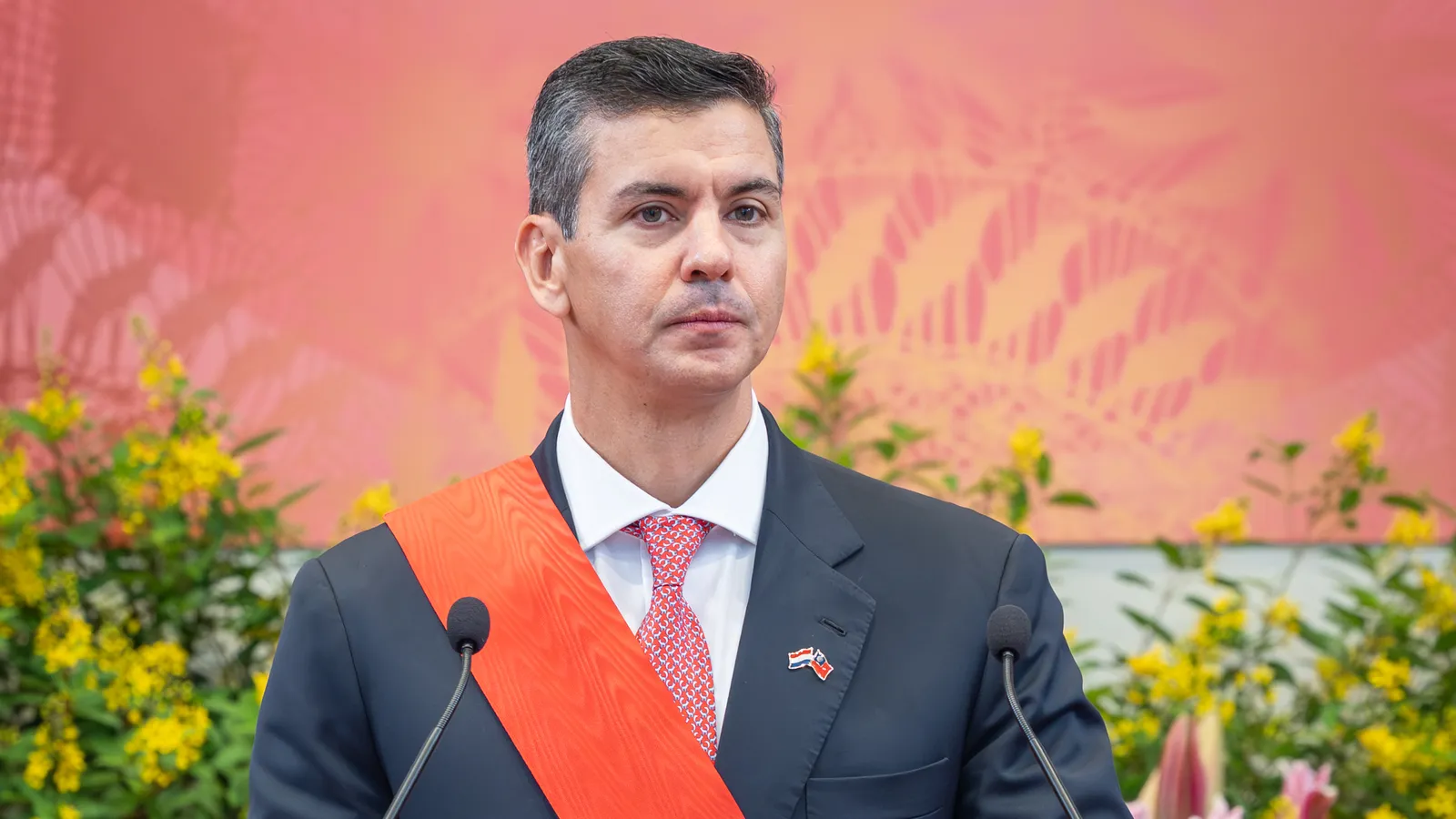
Photo: “Santiago Peña mayo 2026” by Office of the President of the Republic of China (Taiwan) / 總統府, Wikimedia Commons, CC BY 4.0, cropped to 16:9 and scaled to 1600x900 (WebP)
Removal needs 30 of the 45 senators. If Peña leaves office by either route, Vice President Pedro Alliana takes over and serves the rest of the term to August 2028. For foreigners living in Paraguay or applying for residency, nothing in the migration law changes on Friday, and we explain below what could change later.
How Peña's Resignation Unfolded
Peña made the announcement in a recorded video on X. "I have decided to present my resignation as President of the Republic," he said, adding that "no office can be above the well-being of Paraguay" and that he was acting with the country's stability in mind (our translations). He also apologized "if at some point I have failed".
Within hours his position shifted. Faced with an impeachment that was going ahead regardless, he said he would appear and exercise his right to a defense, La Nación of Buenos Aires reported. He also asked lawmakers not to let his fate delay the Ueno payouts: "Payment to savers cannot be left waiting on what happens to me."
The trigger was his party. Horacio Cartes, president of the governing Colorado Party (ANR) and once Peña's political patron, announced that the party would back impeachment, saying it would "not be on the side of the plunder of public, private and pensioners' funds". Natalicio Chase, who leads the Colorado senators, had called for Peña to resign. That morning, the head of the Chamber of Deputies, Raúl Latorre, had still described the president as convinced of his innocence.
Why Congress Did Not Accept the Resignation
The Constitution gives Congress the power to accept or reject a president's resignation. On Thursday a joint session convened for that purpose lost its quorum. La Nación of Asunción attributes the collapse to the deliberate absence of several legislative blocs that blocked a negotiated exit, while Infobae reports that Colorado legislators who favored acceptance walked out when they were losing the vote.
There is a practical reason the route matters. Under Article 189 of the Constitution, democratically elected former presidents become lifetime senators, with a voice but no vote, unless they were impeached and found guilty. A resignation would keep that door open, while a conviction closes it.
The Impeachment Trial in the Senate
The Chamber of Deputies approved the accusation by 78 votes to none, under Article 225, which allows impeachment for poor performance of duties. The charge, as reported, is "serious and systematic" poor performance linked to the Ueno Bank crisis. The same chamber voted 48 to 30 against impeaching Alliana, which clears his path to the presidency.
| Step | Status as of early 6 November |
|---|---|
| Resignation | Announced 5 November; not accepted, after the joint session lost quorum |
| Chamber of Deputies | Impeachment approved 78–0; eight deputies named as prosecutors |
| Senate | Constituted as a court on Thursday evening; Peña summoned for 10:00 Friday |
| Removal threshold | Two-thirds: 30 of 45 senators |
| Successor | Vice President Pedro Alliana, to August 2028 |
| Vice presidency | Congress would pick a replacement by absolute majority (Article 234) |
Senate president Basilio Núñez said the aim is to finish the trial on Friday if procedural deadlines allow. Paraguay has moved this fast before: in 2012 the Senate removed Fernando Lugo, 39 votes to 4, less than 48 hours after the lower house voted to impeach.
Separately, Attorney General Emiliano Rolón passed a criminal complaint against Peña to the anticorruption unit, La Nación of Buenos Aires reported. No charge against him has been reported. His link to the case is his former stake in the Ueno group's holding: AP and La Nación date the sale to March 2025, ABC Color to April. Ueno has said he was never a shareholder of the bank. Carlos Carvallo, the central bank chief Peña appointed in 2023 after Carvallo ran Ueno, has resigned.
On the street, protesters clashed with police near Congress on Thursday evening. Peña canceled a trip to the Ibero-American summit in Spain. The guaraní fell 5.4% against the dollar on the day, and country risk briefly jumped to 157 basis points, as our Ueno Bank follow-up details.
What a Change of President Means for Residency in Paraguay
Here our reporting ends and our assessment begins. It is our reading of the law and the week's events, not legal advice.
The law does not move with the president. Residency in Paraguay rests on Ley N° 6984/2022, an act of Congress. It was passed under President Mario Abdo Benítez and applied without interruption under Peña. Changing it takes a new law, which a resignation or impeachment does not produce. Temporary and permanent residence permits already granted, and cédulas already issued, stay valid. As of early 6 November we have found no Migraciones notice suspending or changing any procedure.
The succession is built for continuity. Alliana is from the same party, takes over automatically under Article 234, and governs until the 2028 handover. Paraguay's last early change of president, in 2012, did not rewrite its immigration rules either. In practice the base case is the same agencies applying the same requirements, perhaps under new heads.
The executive layer can shift. Not every rule is a law. The director of Migraciones is appointed by the executive, and some recent changes came by resolution, not by statute. The solvency rules for permanent residency arrived with Resolución DNM 407/2026, and the Investor Pass tiers were set by a ministry resolution, as our Investor Pass report explains. A new government can revise instruments like these without Congress. Nothing of the kind has been announced, but it is the place to watch.
What Applicants Should Do Now
- ▹Keep your appointments. Migraciones offices have not announced closures. Demonstrations have centered on Congress in downtown Asunción, so allow extra time on days with protests.
- ▹Expect possible delays, not new rules. Leadership changes at agencies can slow approvals and sign-offs for a while. Build slack into a residency timeline rather than assuming the requirements will change.
- ▹Check your bank paperwork. If a solvency or income document was issued by Ueno, it cannot be refreshed for now. Line up alternatives early.
- ▹Watch for the first appointments. Who Alliana names to Migraciones, the economy ministry and the tax agency DNIT will say more about policy than this week's headlines.
Taxes follow the same logic. Paraguay's territorial system sits in Ley N° 6380/2019, so changing it would also need Congress, and an August proposal to raise income tax rates was dropped within a day. Paraguay taxes local-source income, and residence alone does not make foreign income tax-free; our guide to Paraguay tax residency sets out the conditions.
For US citizens and green-card holders, the political news changes nothing about home-country tax: the United States taxes them on worldwide income wherever they live, and Paraguayan residency does not end that. The US persons guide covers FEIE and its limits.
Political risk is real, and this week showed weak spots in bank supervision. Anyone weighing a move should weigh that alongside a legal framework that has so far held steady across governments, rather than reading either as the whole picture.
Frequently Asked Questions About Peña's Resignation
Is my Paraguayan residency still valid if Peña leaves office?
Yes. Residence permits and cédulas are issued under Ley 6984/2022, which remains in force regardless of who is president. We have seen no Migraciones notice changing their validity or the application process as of 6 November 2026.
Who becomes president of Paraguay if Peña is removed or his resignation is accepted?
Vice President Pedro Alliana, under Article 234 of the Constitution, for the rest of the term ending in August 2028. Because the vacancy falls in the last two years of the term, Congress would then choose a new vice president by absolute majority.
Can the new government change Paraguay's residency requirements?
The core rules sit in a law that only Congress can amend. Administrative resolutions from Migraciones and ministries, such as the 2026 solvency rules and Investor Pass tiers, can be revised by the executive. No such change has been announced.
Weighing a move to Paraguay this week? We look after the residency and cédula process on site, with a Paraguayan partner lawyer, and leave the political judgment to you. See how the residency and cédula service works.
As of 6 November 2026, about 03:30 in Asunción, before the Senate session at 10:00. This is a developing story based on press reports; the outcome of the trial and the status of the resignation may change today. Nothing here is legal or tax advice; check current requirements with Migraciones or a Paraguayan lawyer before acting.
Sources
- ▹Infobae: Santiago Peña renunció a la Presidencia pero el Congreso no la aceptó (5 November 2026)
- ▹La Nación (Buenos Aires): Qué se sabe de la renuncia de Santiago Peña (5 November 2026)
- ▹La Nación (Asunción): Avanza en el Senado el juicio político a Peña pese a renuncia (6 November 2026)
- ▹Infobae / agencies: El Senado concluye la primera sesión del juicio político a Peña (6 November 2026)
- ▹La Nación (Asunción): Diputados rechaza juicio político contra Pedro Alliana (5 November 2026)
- ▹RPP: Santiago Peña renuncia al cargo de presidente de Paraguay (5 November 2026)
- ▹BACN: Constitución Nacional del Paraguay, full text
- ▹BACN: Ley N° 6984/2022 de Migraciones

About the author
Yannick Schroth
Founder · Paraguay relocation support
Spends regular time in Paraguay and, with his team on the ground in Asunción, guides international nomads, entrepreneurs and investors through residency, the cédula and the RUC paperwork.