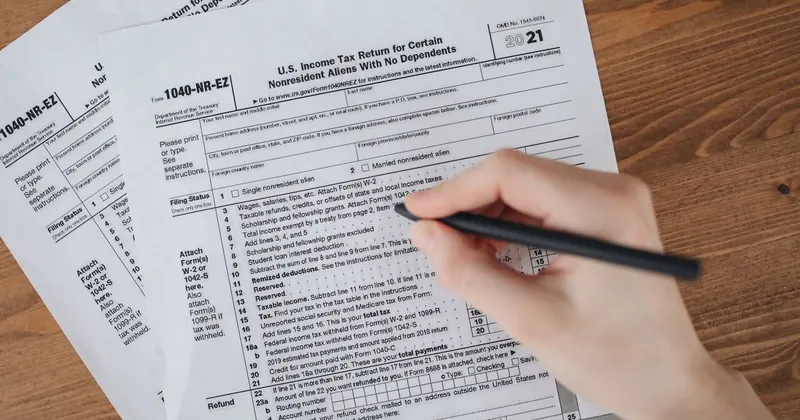
You form a Wyoming LLC, move to Paraguay, check how online income is taxed, and assume the US side is finished the moment the company exists. It is not. A foreign-owned single-member US LLC has one annual obligation it cannot ignore: Form 5472, attached to a pro-forma Form 1120, reporting the money that moved between the LLC and you, its foreign owner. Miss it and the penalty starts at $25,000 per year, whether or not the LLC owed a single dollar of US income tax.
This is the filing people discover late, usually from an IRS notice rather than a calendar reminder.
I have watched more than one entrepreneur set up the structure beautifully, bank cleanly, invoice correctly, and then leave the one mandatory federal filing undone because nobody told them it existed. The good news is that the form is not hard, not expensive, and entirely routine for a specialist; the penalty for forgetting it is another matter. This article walks through what Form 5472 is, why a disregarded LLC still files it, what a reportable transaction means, the $25,000 penalty, and how it fits the US-LLC-plus-Paraguay setup.
Why Form 5472 Is the Filing a Foreign-Owned US LLC Cannot Skip
Since 2017, the IRS treats a foreign-owned single-member US LLC that is disregarded for tax purposes as a domestic corporation for one narrow purpose: information reporting. That single rule change is why Form 5472 exists in your life. The entity that pays no US corporate tax, files no ordinary business return, and often owes nothing at all is still required to tell the IRS, once a year, what flowed between it and its foreign owner.
The logic is straightforward. The US wants visibility into foreign-owned entities operating through its system, even ones that produce no taxable income, and the form is that window. It is not a tax calculation or a bill; it is a disclosure, mandatory regardless of the tax outcome. As of 2026, a foreign-owned disregarded LLC that had any reportable transaction during the year generally must file, and most active LLCs have at least one.
So the first thing to internalize is that "no tax due" and "no filing due" are two different statements. Your LLC can owe zero US income tax and still be required to file the form. Treating the two as the same is the most common and expensive mistake in this whole area.
What the Form Actually Is: An IRS Information Return
Form 5472 is titled, in full, the Information Return of a 25% Foreign-Owned US Corporation or a Foreign Corporation Engaged in a US Trade or Business. The wording sounds intimidating, but for a non-US owner of a small US LLC who lives in Paraguay the relevant part is simple: your single-member LLC counts as 100% foreign-owned, so the form applies (a US citizen or green-card holder living in Paraguay is not a foreign owner).
An information return does one job. It reports facts to the IRS rather than computing a payment. On the form you identify the LLC (name, address, EIN), you identify the foreign owner (that is you: name, country of tax residence, tax ID), and you disclose the transactions between the two of you during the year. There is no tax line and no balance due at the bottom.
This is where the "0% tax does not mean 0% paperwork" idea becomes concrete. A non-US owner whose LLC has no US trade or business, and therefore no effectively connected income (ECI), typically owes no US income tax on the LLC's profit, a point a US tax professional should confirm for your own case. None of that removes the filing obligation, and the IRS enforces it hard.
Why a Disregarded US LLC Files Form 5472 With a Pro-Forma 1120
Here is the mechanical quirk that confuses everyone. A single-member LLC owned by a non-US person is, by default, a disregarded entity: the IRS looks straight through it and does not normally expect a corporate return from it. Yet Form 5472 cannot be filed on its own; it must be attached to a return. So the rules require the disregarded LLC to file a pro-forma Form 1120 purely as a cover sheet to carry the 5472.
"Pro-forma" means you do not fill in the 1120 the way a real C-corporation would. You report no income, deductions, or tax on it. You complete only the top identifying section (the LLC's name, address, and EIN), write "Foreign-owned US DE" across the top, then staple the 5472 to it. The 1120 here is a vehicle, not a tax computation; the substance is entirely in the disclosure.
That combination, a pro-forma 1120 with Form 5472 attached, is the annual package, filed together once a year by mail or fax to a specific IRS address (a disregarded entity generally cannot e-file it the way an ordinary corporation would). None of it changes the pass-through nature of your LLC or creates a US tax; it is disclosure machinery bolted onto an entity that otherwise files nothing.
What Counts as a Reportable Transaction for Your US LLC
Form 5472 reports reportable transactions between the LLC and its foreign owner, and for a foreign-owned disregarded entity the definition is broad. It captures far more than sales. Money you contribute to capitalize the LLC, money you take out as the owner, and amounts the LLC pays on your behalf are all the kind of thing the form is asking about.
For a typical one-person online business, the common reportable items are the capital you put in to fund the account and the distributions you took out to pay yourself. Even the formation year usually has a reportable transaction, because you contributed the initial funds to open the bank account, which is why a brand-new LLC with no revenue still often has to file.
The practical takeaway is to keep records. You do not need elaborate accounting, but you do need to know, at year end, how much moved between you and the LLC and in which direction. Clean bookkeeping is what makes the reportable-transaction figures easy to complete rather than a year-end reconstruction.

The $25,000 IRS Penalty for Not Filing the Return
This is the number that makes the form worth taking seriously. As of 2026, the penalty for failing to file Form 5472, filing it late, or filing it substantially incomplete starts at $25,000. It is a per-form, per-year penalty, and it is not proportional to the size of your business or the tax at stake. A tiny LLC that earned modest income and owed no US tax faces the same $25,000 starting penalty as a large one if the form is simply not filed.
It gets worse if the IRS notifies you and you still do not file: additional amounts can accrue after the notice period. The penalty is assessable even when no US income tax was ever due, because it attaches to the filing failure, not to any underpayment. That is the mechanism that turns a forgotten form into a five-figure problem for someone who genuinely owed the US nothing.
There is a reasonable-cause relief path if the failure was not wilful, but relief is never guaranteed and fighting an assessed penalty costs time and fees. The cheaper strategy is to file on time, every year: against a $25,000 downside, the cost of a specialist preparing the form is trivial.
0% Tax Does Not Mean 0% Paperwork for Your US LLC
The line I keep returning to whenever this structure comes up is that 0% tax does not mean 0% paperwork. Paraguay's territorial tax system may leave your foreign-source income untaxed, and your foreign-owned US LLC may produce no US income tax, yet the annual filing duties are still real, still dated, and still enforced.
For the US LLC specifically, the recurring paperwork is Form 5472 with its pro-forma 1120. But it does not stop there. Depending on your facts you may also encounter personal US information filings that have nothing to do with the LLC's income, such as the FBAR and FATCA reporting that can apply to certain account holders, which I cover in the FBAR and FATCA guide for expats. The point is that a low-tax life is an organized life, not a paperwork-free one.
Some owners treat compliance as finished once the LLC exists. It is the reverse: the lower your tax, the more your legitimacy rests on clean, timely filings, and filing Form 5472 on time is part of keeping the structure compliant.
Not sure whether your LLC has a Form 5472 obligation this year? That answer has to come from a US preparer who files foreign-owned LLC returns, ideally well before mid-April. For the Paraguay side of your plan, from residency and the cédula to the RUC, get in touch.
How Form 5472 Fits the US-LLC-Plus-Paraguay Structure
The form is not a complication that undermines the structure; it is a normal, expected part of it. The whole point of the US-LLC-plus-Paraguay setup is that each side does its job cleanly, and the US side's job includes this filing. When people describe the structure as "0% and simple," the simplicity is real, but it assumes the annual US filing is being done in the background by someone competent.
Sequence it like this. Your Paraguay tax residency, a question of Paraguayan law for a contador, decides how Paraguay treats your income. Your US LLC is the vehicle that makes invoicing foreign clients and banking easy. And Form 5472 is the annual receipt you file with the IRS confirming what moved between you and the vehicle. All three coexist.
One limit matters on the Paraguay side: the LLC does not by itself make your income foreign. Service work you perform from a desk in Paraguay can be classed as Paraguayan-source income (IRP of 8 to 10%, or 10% IRE for a business), even with a foreign client and a foreign company on the invoice, while income earned outside the country stays outside the local tax net in principle. Before you rely on 0%, have one of the partner tax advisers in Paraguay look at how your setup is classified.
What the form does not do is create a US tax where there was none. Filing it discloses your transactions; it does not convert non-taxable pass-through profit into taxable income. Form 5472 is visibility, not liability, and that distinction is what keeps people from panicking when they first hear about it.
Deadlines and How to File Your LLC's Return Correctly
Timing matters. The Form 5472 package (the pro-forma 1120 plus the attached 5472) is generally due by the fifteenth day of the fourth month after the LLC's tax year ends, which for a calendar-year LLC means April 15 of the following year. Filing Form 7004 by that date extends the deadline to October 15, but an extension of time to file is not an extension of your duty to file, and it does not shrink the penalty for simply forgetting.
Because a foreign-owned disregarded LLC generally cannot e-file this package through ordinary channels, it is typically submitted by mail or fax to the dedicated IRS address for these returns. That trips up people who assume every US form goes through consumer tax software. Getting the delivery method and address right is one more reason the do-it-yourself route has hidden edges.
You also need the LLC's EIN before you can file, because it is the identifier the whole filing hangs on. If you formed the LLC recently and are still waiting on the EIN, resolve that early. Keep your EIN confirmation letter, your formation documents, and your record of owner transactions together, so that when filing season arrives your preparer has everything in one place.
Keeping Your Wyoming LLC in Good Standing Beyond the Filing
Form 5472 is the federal filing, but it is not your only annual obligation. Your LLC also lives under state law, and the state (Wyoming, in the common case) expects its own annual maintenance: the annual report and fee that keep the company in good standing. Miss those for long enough and the state can dissolve the LLC, undermining everything the structure was built to hold.
These are two separate tracks that people conflate. The IRS gets Form 5472 with its pro-forma 1120; Wyoming gets its annual report and fee. Neither substitutes for the other, and you keep both current, plus your registered-agent arrangement, which the state requires you to maintain continuously.
Think of the annual rhythm as a short checklist: the federal filing package, the state annual report and fee, the registered agent, and your basic bookkeeping. It is genuinely light once someone sets it up, but it is not nothing, and the whole thing falls over if you assume forming the LLC was a one-time act rather than the start of a small annual routine.
Who Should Handle the Filing: Why You Want an LLC Specialist
Could you file Form 5472 yourself? In principle, yes; in practice, almost nobody should, because of the asymmetry between cost and risk. A specialist who prepares foreign-owned LLC filings all day does this quickly and inexpensively, often for a few hundred dollars a year. A first-timer doing it alone risks a $25,000 penalty over a completeness error, a wrong address, or a missed deadline they did not know existed.
The right specialist is a US-qualified preparer (an enrolled agent or CPA) who specifically handles non-resident-owned US LLCs. A general preparer who rarely sees foreign-owned disregarded entities may not know the pro-forma 1120 mechanics or the dedicated filing channel, whereas someone who files these routinely treats your return as a standard product. Ask directly how many foreign-owned single-member LLCs they file for; the answer tells you what you need to know.
This is also the clean division of labor in the structure. Your US preparer handles Form 5472 and the US side; your Paraguay-side team handles the residency, the cédula, and local filings. Neither should improvise in the other's domain. Getting the US filing done by someone who does only this is the cheapest insurance you will buy all year.
US citizens and green-card holders: A US LLC's pass-through profit is taxed on your US return no matter where you live; this article's "no US income tax" framing is for NON-US owners. Consult a US-qualified advisor and see our US citizens and Paraguay taxes guide.
Keeping a US preparer on the LLC filings while you plan the move? Our packages cover the Paraguayan half, residency through the cédula, and Premium brings the RUC inscription in as well. Form 5472 and other federal returns sit outside every package. View the packages.
Frequently Asked Questions About Foreign-Owned LLC Filings
Who has to file Form 5472 for a US LLC?
Form 5472 is filed by "reporting corporations" that had a reportable transaction: a US corporation at least 25% foreign-owned (including an LLC taxed as a corporation), a foreign corporation with a US trade or business, and a foreign-owned US LLC disregarded for tax purposes. An LLC taxed as a partnership falls outside it. For a single-member LLC owned entirely by a non-US person and treated as disregarded, that means you file it annually, attached to a pro-forma Form 1120, in nearly all active years.
Does a foreign-owned US LLC owe US tax when it files?
Not necessarily. Form 5472 is an information return, not a tax bill. A foreign owner with no US trade or business generally owes no US income tax on the LLC's profit, yet still must file the form. The filing discloses transactions; it does not by itself create any US tax liability.
What is the penalty for not filing Form 5472?
As of 2026, the penalty for failing to file Form 5472, or filing it late or substantially incomplete, starts at $25,000 per form per year. It applies even when no US income tax was due, because it attaches to the filing failure itself. Additional amounts can accrue if you ignore an IRS notice.
Why does a disregarded LLC file Form 5472 with a Form 1120?
Because Form 5472 cannot be filed alone, the rules require a foreign-owned disregarded LLC to attach it to a pro-forma Form 1120. You complete only the 1120's identifying header, mark it as a foreign-owned disregarded entity, and staple the 5472 to it. The 1120 is a cover sheet, not a tax computation.
When is Form 5472 due for my US LLC?
For a calendar-year LLC, the Form 5472 package is generally due by April 15 of the following year, on the same timeline as a corporate return. Form 7004, filed by that date, pushes the deadline to October 15, but it does not remove the underlying duty to file.
Can I file Form 5472 myself or do I need a specialist?
You legally can, but the $25,000 penalty for errors makes a specialist the sensible choice. A US-qualified preparer who handles non-resident-owned LLCs files these returns routinely and inexpensively, knows the pro-forma 1120 mechanics and the dedicated filing channel, and removes the completeness risk that catches people doing it alone.
Does filing Form 5472 replace my Wyoming annual report?
No. Form 5472 is a federal IRS filing; the Wyoming annual report and fee are a separate state obligation. Both must be kept current, along with your registered agent. A filed federal return does nothing to keep your Wyoming LLC in good standing, and vice versa, so treat them as two distinct annual tasks.
Legal basis and disclaimer: This article is general information, not individual US tax or legal advice, and rules can change. US federal tax rules for foreign-owned LLCs are published by the Internal Revenue Service (IRS), and Wyoming LLC requirements by the Wyoming Secretary of State. Consult a US-qualified adviser before you act. the PwC tax summary sets out the US filing environment independently.

About the author
Yannick Schroth
Founder · Paraguay relocation support
Spends regular time in Paraguay and, with his team on the ground in Asunción, guides international nomads, entrepreneurs and investors through residency, the cédula and the RUC paperwork.
Note: this article reflects the position at the time of publication. Laws, prices and deadlines can change, so individual details may since be out of date. Check the current rules before you act on them: we answer questions about residency and our services, while the tax treatment of your own case belongs with a qualified tax adviser.